Ice Cream Franchise Royalty Explained: 6% + GST on Net Sales
A plain guide to the MilkyWay ice cream franchise royalty of 6% + GST on net sales. It explains how a royalty differs from a one-time franchise fee and what support continues after launch. It also shows why your outlet's GST classification decides whether the GST on the royalty becomes a cost. A worked example with invented monthly figures shows the arithmetic and makes no promises about income or payback.
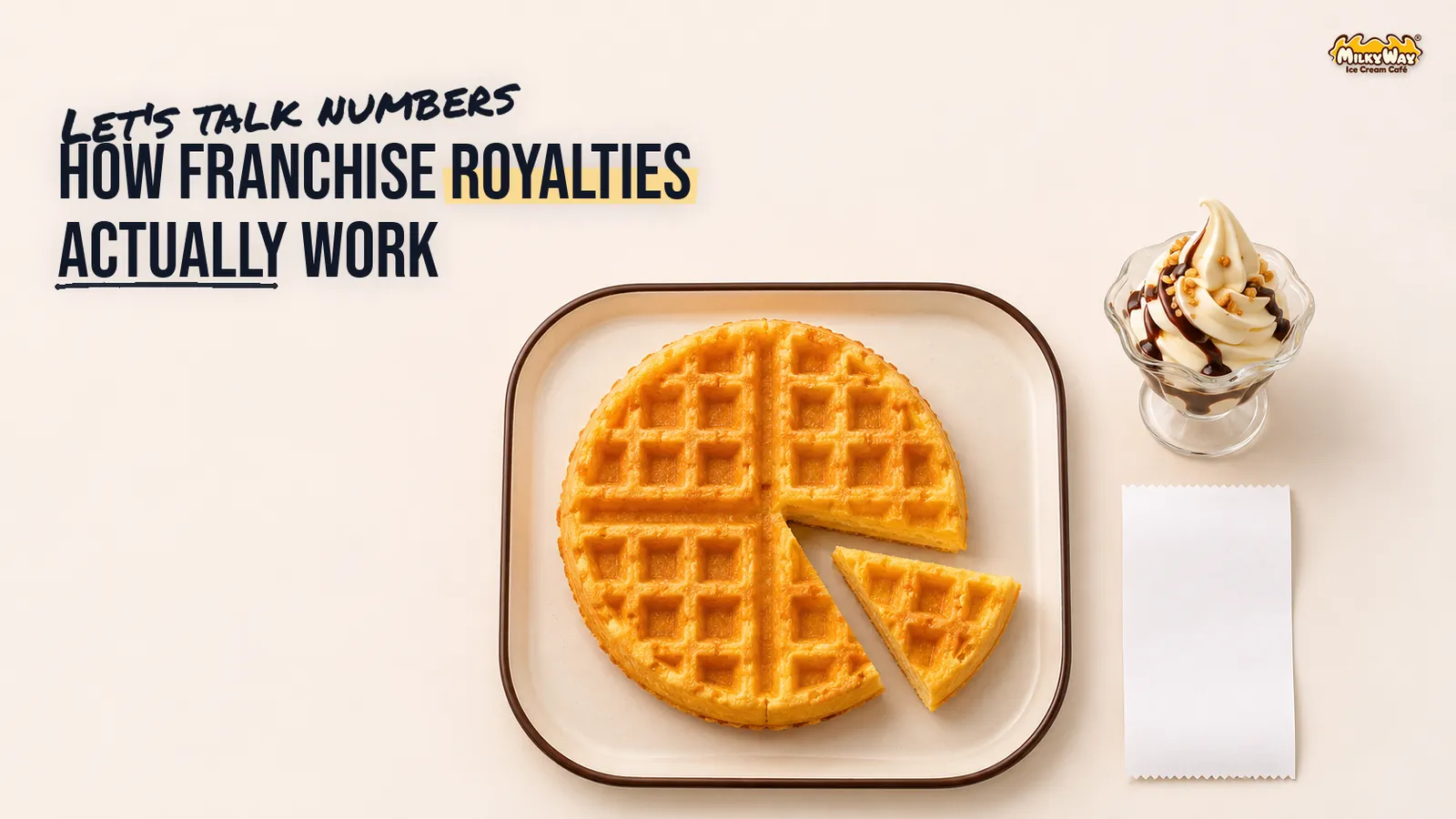
Most prospective partners study the upfront investment closely and give far less attention to the charge that continues for as long as an outlet trades: the ice cream franchise royalty. At MilkyWay, the applicable royalty is 6% + GST on net sales, as per the franchise agreement and selected business model, as published on our franchise page in 2026. This guide explains how that royalty is calculated, how it differs from a one-time franchise fee and what we provide in return.
Key takeaways
- A royalty is a recurring percentage of sales, whereas a franchise fee is typically a one-time amount paid before opening.
- Our royalty is charged on net sales, so the payment rises and falls with what an outlet actually sells.
- GST is added to the royalty, and whether you can recover that GST depends on how your outlet's own sales are classified for tax.
- The royalty sits alongside continuing support: training, a proven menu, marketing and branding, and operational guidance.
- The worked example below is arithmetic only and is not a forecast of sales, profit or payback.
At a glance
- Royalty: 6% + GST on net sales
- Franchise fee: May apply depending on the franchise model; the complete structure is shared during the franchise discussion
- Investment: Starts from ₹25 lakh, depending on location, size, interiors and equipment
- Launch timeline: Typically 30 to 45 days after site approval and formalities, subject to project readiness
- Experience needed: No prior restaurant experience; we provide training and operational guidance
- Network: 20+ outlets across Chennai, Madurai, Sivakasi, Bengaluru and Port Blair
Every figure in this list comes from our franchise page as published in 2026.
What is an ice cream franchise royalty, and why do brands charge one?
An ice cream franchise royalty is a recurring payment, normally expressed as a percentage of sales. The franchisee, meaning the person who owns and operates the outlet, pays it to the franchisor, meaning the brand that licenses its name, recipes and operating systems. The royalty compensates the franchisor for continued use of its identity and for the support it keeps supplying.
Much of what a royalty buys is intangible. Accountants call that asset goodwill, which is the recognition and trust attached to an established brand name. An independent dessert counter must accumulate goodwill gradually, customer by customer, whereas a franchise partner begins with an existing reputation, documented recipes and procedures already tested in other neighbourhoods.
Goodwill matters most at the precise moment a customer decides where to go. When a family types ice cream shops near me into a phone, a familiar name can shorten that decision considerably. MilkyWay ice cream has been served since 1994, when Tamil Nadu's first branded softy ice cream showroom opened in Egmore, opposite Ethiraj College.
That original MilkyWay ice cream cafe in Chennai has since grown into a network of more than 20 outlets, according to our franchise page. A new partner inherits that recognition from opening day rather than building it from nothing.
How does a franchise royalty on net sales work?
A franchise royalty on net sales is calculated on an outlet's revenue after defined deductions, not on the full amount billed to customers. Net sales commonly exclude GST collected from customers and, under some agreements, approved discounts or refunds. The franchise agreement contains the binding definition, so read that clause before any other commercial term.
The calculation base deserves as much scrutiny as the headline percentage. Some franchise systems levy royalties on gross sales, meaning total billing before any deductions. An identical percentage applied to a smaller net figure produces a smaller payment, so two brands quoting the same rate can cost a franchisee noticeably different amounts.
The calculation generally follows a predictable sequence:
- Record total billing: The point-of-sale (POS) system, which is the billing software that logs every counter transaction, captures total receipts for the period.
- Subtract permitted deductions: Remove the items your agreement allows, such as GST collected from customers.
- Apply the rate: Multiply the resulting net sales by the published royalty percentage.
- Add GST: GST is charged on the royalty itself, because the royalty is consideration for a service supplied by the brand.
- Report and pay: The franchise agreement specifies the reporting period and the due date for payment.

How does a food franchise royalty in India differ from a one-time franchise fee?
A food franchise royalty in India is usually a recurring, sales-linked payment, whereas a franchise fee is typically a single amount paid before opening. The fee secures entry into the system; the royalty pays for continuing use of the brand and its support. Investors should evaluate both together, because each behaves differently over time.
The practical distinctions are worth setting out clearly:
- Timing: A franchise fee is generally paid once, around agreement signing, while a royalty recurs for as long as the outlet operates.
- Variability: A fixed fee does not change with trading performance, whereas a royalty on net sales moves in proportion to what the outlet sells.
- Risk sharing: Because the royalty tracks sales, a quieter month produces a smaller royalty, which partly aligns the brand's income with the franchisee's.
- Disclosure: In our model, a franchise fee may apply depending on the franchise model, and the complete fee structure is shared during the franchise discussion.
Investors comparing the total ice cream franchise cost across brands, including those looking at an ice cream franchise in Bangalore, should therefore model three layers: the upfront investment, any one-time fee and the recurring royalty. Our ice cream franchise cost breakdown for India covers the upfront layer in more detail.
What do we provide in return for the royalty?
In return for the royalty, we provide support that begins before opening and continues afterwards: site evaluation, store setup, training, recruitment assistance, a proven menu of 100+ items, marketing and branding, and ongoing operational support. These elements are listed on our franchise page, and the agreement for your selected model sets out the detail.
Before opening
- Location evaluation and site selection: Our team reviews potential, visibility, accessibility and catchment, meaning the surrounding area from which an outlet draws customers, before approving a site.
- Store setup and equipment procurement: We provide equipment guidance and procurement assistance throughout the setup process.
- Training for you and your staff: Training covers product preparation, store operations, customer service and basic reporting, so prior restaurant experience is not required.
- Staff recruitment support: We help with recruitment where a partner needs it.
After opening
- A proven menu: Partners serve softy sundaes, scoops, waffles, thick shakes, coolers, natural ice creams and vegetarian quick eats, all drawn from the Full MilkyWay menu.
- Marketing and branding: The outlet trades under a brand customers have recognised since 1994.
- Ongoing operational support: Our franchise team remains available for operational guidance after launch.

What does the royalty look like in a worked example?
The example below uses invented figures purely to demonstrate the arithmetic. The figures are not projections of what any outlet will sell, earn or recover, and actual results depend on location, operations and many other factors. For illustration, GST on the royalty is assumed at 18%, the rate discussed for franchise fees in a Gujarat advance ruling (GST Council, 2020); confirm the current rate before relying on it.
Example A (invented month, higher sales)
- Total billing for the month: ₹6,30,000, including ₹30,000 of GST collected from customers
- Net sales after removing that GST: ₹6,00,000
- Royalty at 6%: ₹36,000
- GST on the royalty at the assumed 18%: ₹6,480
- Total payable to the brand for the month: ₹42,480
Example B (invented month, lower sales)
- Net sales for the month: ₹3,00,000
- Royalty at 6%: ₹18,000
- GST on the royalty at the assumed 18%: ₹3,240
- Total payable to the brand for the month: ₹21,240
The comparison illustrates the defining feature of a sales-linked royalty: when monthly net sales halve, the royalty per month halves too. A fixed monthly charge would have stayed the same in both months, regardless of trading conditions.
Does the GST on the royalty become a cost?
Whether GST on the royalty becomes a genuine cost depends on input tax credit (ITC), the mechanism that lets a registered business offset GST paid on its purchases against GST due on its own sales. If your outlet's supplies are taxed in a way that permits ITC, the GST on the royalty can usually be set off. If they fall under a rate that does not permit ITC, that GST stays as a cost.
Classification is therefore central. The Central Board of Indirect Taxes and Customs (CBIC) has addressed how ice cream parlours are treated:
Ice cream sold by a parlour that does not cook or prepare it like a restaurant is a supply of goods, not a restaurant service (CBIC Circular No. 164/20/2021-GST, 2021).
Share on LinkedIn · Share on X
An outlet that also serves freshly prepared vegetarian quick eats may have a mix of supplies, and GST rates are revised by notification from time to time. Ask a chartered accountant to confirm your outlet's classification and ITC position before you finalise your financial plan.
Frequently asked questions
What is the MilkyWay franchise royalty?
The applicable royalty is 6% + GST on net sales, as per the franchise agreement and selected business model. The royalty is a recurring payment calculated on what your outlet sells, not a fixed monthly amount.
Is the royalty charged on gross sales or net sales?
Our royalty is charged on net sales. Net sales typically exclude GST collected from customers, and the franchise agreement gives the binding definition of any further deductions.
Can I claim input tax credit on the GST charged on the royalty?
That depends on how your outlet's own sales are classified for GST, as explained in the section on GST on the royalty above. A chartered accountant should confirm your position before you rely on any credit.
Does paying an ice cream franchise royalty guarantee sales or profit?
No. A royalty is a charge for using the brand and its support, and earnings depend on location and operations. The worked example in this guide demonstrates arithmetic only.
Is there a franchise fee as well as the royalty?
A franchise fee may apply depending on the franchise model. Our franchise team shares the complete fee structure and other applicable costs during the franchise discussion.
What this means for you
If you are evaluating a MilkyWay franchise, treat the royalty as a percentage of every rupee of net sales and build it into your planning from the first month. A practical sequence looks like this:
- Read the net sales definition: Confirm exactly which deductions apply before comparing brands on headline percentages.
- Model several sales scenarios: Apply the 6% royalty and GST to cautious, moderate and stronger months so that no single estimate shapes your decision.
- Check your GST position early: Ask a chartered accountant whether the GST on the royalty will be recoverable for your outlet.
- Ask for the full breakup: Request the detailed investment breakup and fee structure for your proposed site during the business discussion.
Before that conversation, it helps to see the brand from a customer's seat. Browse the full menu your outlet would serve, or use our store finder to visit an existing cafe near you.
When you are ready to discuss the royalty, the fee structure and the investment breakup for your city, our franchise team will walk you through each one.
Book a 15-minute franchise call
Related resources
- Franchise Opportunities
- Business Guides
- ice cream franchise royalty
- franchise royalty on net sales
- food franchise royalty India
- milkyway ice cream
- milkyway ice cream cafe chennai
- ice cream shops near me
- ice cream franchise cost
- ice cream franchise in bangalore
- ice cream franchise royalty per month